
The festival of Sukkot is a joyous celebration that brings the yearly festival cycle to a close and gives a wonderful end to the fall feasts. The entire story of redemption, sanctification, and the eschatological reign of the Messiah is told in the five biblical festivals. Sukkot and Shemini Atzeret (The Eighth Day) are the culmination of this story and carries significant meaning and imagery for the covenant people of God.
The Torah first lists the festival of Sukkot as a commanded celebration in Exodus 23:16 and again in 34:22 as one of three pilgrimage feasts where Israel was to appear before the Lord. In this context the text calls it the “feast of ingathering” or the “feast of harvest” (ve’chag ha’asef). In Leviticus 23:33-43, God expands on this festival noting that it is to be held for seven days (v. 39) and the name now shifts to “sukkot” (booths) to commemorate the exodus and remember that God had the Israelites dwell in booths (v. 43).
Sukkot celebrates the provision God gives His people through the harvest. It also remembers the freedom God gave from Egypt and the way He led His people through the wilderness to the land promised to Abraham. It is a celebration of life and the realization that this world is temporary, just like the sukkah we build. But perhaps more than anything, it is the final celebration in the yearly festival cycle. We as a people have celebrated our redemption at Passover, our sanctification as a covenant people at Shavuot, the coming of our King at Yom Teruah, the atonement made on our behalf by the lamb at Yom Kippur, and now the eternal dwelling with the promised Messiah, Savior, and God. This is why the festival of sukkot is so closely linked to the Temple.
The imagery of Sukkot and the temple carry significant meaning. The temple complex itself is the place in this temporal world where the presence of God dwells. This space is not only sacred but has strict laws and regulations concerning purity. The ritual purity laws are a picture of the relationship we have with the Holy God. Becoming ritually unclean is always related to death in some way. Death is the result of sin and the fall, and thus, the ritual purity laws represent the separation we have due to sin and the means by which we come back to a status of “clean” (i.e. able to enter the space where God dwells).
Ritual purity is only a symbol, as becoming ritually unclean is not a sin. In some cases, such as when a woman menstruates, it is a natural God given function that brings about impurity. This picture shows the separation of man from God and the necessity of innocent blood to be offered in order to come back into the space where God dwells. Thus, it is only fitting the festival of Sukkot takes place at the temple as this represents the eternal dwelling of God with His people in the world to come.
The connection between Sukkot and the temple are made even stronger as both the first and second temple were dedicated during this festival. At the dedication of Solomon’s temple in 1 Kings 8, we are told that the dedication took place at the feast of Sukkot.1 Likewise, Ezra 3:4 notes the second temple was dedicated during this festival as was the celebration when the wall was completed and the Torah was read (Neh. 8:18).
The rabbis associate the festival of Sukkot with God ruling on His heavenly throne. For instance, in Leviticus Rabbah 29, the rabbis have a discussion about when they can cite the merit of the patriarchs to have their sins absolved. The answer given is that God moves from the throne of “justice” to the throne of mercy in the seventh month.
Rabbi Yehuda ben Rabbi Nahman began: “God ascends with a blast, the Lord with the sound of a shofar” (Psalms 47:6). When the Holy One blessed be He sits and ascends on the throne of justice, He ascends in justice. What is the source? “God [Elohim] ascends with a blast.” When Israel take their shofars and sound them before the Holy One blessed be He, He rises from the throne of justice and sits on the throne of mercy, as it is written: “The Lord with the sound of a shofar.” When? In the seventh month. (Yayikra Rabbah 29)2
The idea that the throne of mercy is associated with Sukkot comes from the Talmud where there is a discussion on when the Hallel prayer (Psalms 113-118) should be recited. The answer is they should only be recited on Sukkot because they are to be said during a time of joy, not when the King sits on the throne of judgement:
Master of the Universe, for what reason do the Jewish people not recite songs of praise, i.e., hallel, before You on Rosh HaShana and on Yom Kippur? He said to them: Is it possible that while the King is sitting on the throne of judgment and the books of life and the books of death are open before Him, the Jewish people would be reciting joyous songs of praise before Me? Rosh HaShana and Yom Kippur are somber days of judgment whose mood is incompatible with the recitation of hallel. (b.Arakhin 10b)3
The significance here is the imagery of God’s sovereignty over mankind and that this world comes into physical reality in the world to come. What is more, the Rabbis use imagery of God’s throne to emphasize this. The throne of God represents the various actions and functions He performs. Thus, God moves from the “throne of judgement” to the “throne of mercy” between Yom Teruah and Yom Kippur, in order to properly celebrate Sukkot.
The throne of God can represent various actions or roles that God plays and which are seen within the Tanach. For instance, in certain places, the throne of God can represent power and majesty:
And Micaiah said, “Therefore hear the word of the LORD: I saw the LORD sitting on his throne, and all the host of heaven standing on his right hand and on his left. (2 Chronicles 18:18 ESV)
I saw the Lord sitting upon a throne, high and lifted up; and the train of his robe filled the temple… And one called to another and said: ‘Holy, holy, holy is the LORD of hosts.’ (Iasaih 6:1, 3)
God’s throne can be a place of judgement:
But the LORD sits enthroned forever; he has established his throne for justice. (Psalm 9:7 ESV)
The LORD is in his holy temple; the LORD’S throne is in heaven; his eyes see, his eyelids test the children of man. (Psalm 11:4 ESV)
The throne of God can also be a metaphor for the Kingdom, or more specifically, the Messianic Kingdom:
to transfer the kingdom from the house of Saul and set up the throne of David over Israel and over Judah, from Dan to Beersheba. (2 Samuel 3:10 ESV)
He shall build a house for my name, and I will establish the throne of his kingdom forever. (2 Samuel 7:13 ESV)
The LORD swore to David a sure oath from which he will not turn back: ‘One of the sons of your body I will set on your throne.’(Psalm 132:11 ESV)
Of the increase of his government and of peace there will be no end, on the throne of David and over his kingdom, to establish it and to uphold it with justice and with righteousness from this time forth and forevermore. The zeal of the LORD of hosts will do this. (Isaiah 9:7 ESV)
It is he who shall build the temple of the LORD and shall bear royal honor, and shall sit and rule on his throne. And there shall be a priest on his throne, and the counsel of peace shall be between them both. (Zechariah 6:13 ESV)
Thus, out of the many lessons and symbols we can find at Sukkot, one of the things we celebrate is eternity in the Kingdom of God, when the Messiah reigns from Jerusalem and the King sits upon His throne. Then we, as believers, will be able to dwell in peace with the physical presence of God in our midst.
Beyond a powerful metaphor, Scripture gives us striking imagery of the throne of God. Such imagery comes into our reality when the Kingdom of God is established on earth and the heavenly throne is physically realized in the physical world. Like the earthly temple that has its counterpart in the heavenly realm, the throne of God is a heavenly element that will soon become a temporal reality. This is something we as believers pray for on a regular (if not daily) bases when we pray:
Our Father in heaven, may your name be sanctified. May Your kingdom come, your will be done, on earth as it is in heaven. (Matthew 6:9–10)
Within this prayer that believers say so often, we ask for the Kingdom of God (the throne) to be established on earth, “as it is in heaven.” What does this look like? What exactly are we asking for? When we consider the holy of holies in the heavenly realm, we probably have an image in our minds of what this resembles. Why? Because God has given us a physical representation of it here on earth. However, when it comes to the heavenly imagery of the throne of God, many people think this is just a metaphor, or perhaps a dream that represents a concept but is nothing like reality. But is this what the Scriptures actually portray? In what follows I hope to survey three texts that describe the throne of God in the heavenly realm, and then compare it to the earthly throne described by Zechariah and John here on earth. But first we must look at some preliminary issues.
In Exodus 33, Moses asks God to see his glory. God responds, “you cannot see my face, for man shall not see me and live.” This statement has two elements that should be noted. First, God states that no one can see His face, something the text just said Moses did regularly:
And when all the people saw the pillar of cloud standing at the entrance of the tent, all the people would rise up and worship, each at his tent door. Thus the LORD used to speak to Moses face to face, as a man speaks to his friend. When Moses turned again into the camp, his assistant Joshua the son of Nun, a young man, would not depart from the tent. (Exodus 33:10–11)
The second element from 33:20 we need to note is that God states “man shall not see me and live.” This striking statement seems to be another contradiction as the Torah has already described several instances when people have seen God:
And the LORD appeared to him by the oaks of Mamre, as he sat at the door of his tent in the heat of the day. He lifted up his eyes and looked, and behold, three men were standing in front of him. (Genesis 18:1–2)
Then Moses and Aaron, Nadab, and Abihu, and seventy of the elders of Israel went up, and they saw the God of Israel. There was under his feet as it were a pavement of sapphire stone, like the very heaven for clearness. (Exodus 24:9–10)
And Jacob was left alone. And a man wrestled with him until the breaking of the day… So Jacob called the name of the place Peniel, saying, “For I have seen God face to face, and yet my life has been delivered. (Genesis 32:24, 30)
Perhaps the most common suggestion regarding Exodus 33:20 is that God is specifically stating no one can see the fullness of His glory. Yet, the Holy One can suppress His glory, as it were, in order to interact with humans in this work. Eugene Carpenter represents this view well:
He limits the goodness he will permit Moses to behold–he can-not see his face, his fullness. Moses talked with Yahweh “face to face” (v. 11 above), but the assertion is metaphorical. Here, though the term is analogical, attempting to describe God, its intent is literal. The face of God cannot be seen by a human being, for he/she would die from the full revelation of God’s goodness, splendor, and glory, even though humans are in a finite way the divine image itself.4
While this does seem like a logical interpretation of the passage, it is not what the Scriptures seem to convey. For instance, when Gideon meets the Angel of the Lord he believes he is going to die:
Then the angel of the LORD reached out the tip of the staff that was in his hand and touched the meat and the unleavened cakes. And fire sprang up from the rock and consumed the meat and the unleavened cakes. And the angel of the LORD vanished from his sight. Then Gideon perceived that he was the angel of the LORD. And Gideon said, “Alas, O Lord GOD! For now I have seen the angel of the LORD face to face.” But the LORD said to him, “Peace be to you. Do not fear; you shall not die.” (Judges 6:21–23)
Likewise, Samson’s parents believe they will parish when they meet the Angel of the Lord who tells them they will have Samson:
The angel of the LORD appeared no more to Manoah and to his wife. Then Manoah knew that he was the angel of the LORD. And Manoah said to his wife, “We shall surely die, for we have seen God.” But his wife said to him, “If the LORD had meant to kill us, he would not have accepted a burnt offering and a grain offering at our hands, or shown us all these things, or now announced to us such things as these.” (Judges 13:21–23)
The prophet Isaiah also believes he will die when he sees God sitting on His throne in heaven:
And I said: ‘Woe is me! For I am lost; for I am a man of unclean lips, and I dwell in the midst of a people of unclean lips; for my eyes have seen the King, the LORD of hosts!’ (Isaiah 6:5)
Yet, such a view is not held exclusively by those in the Tanach, the Apostolic writers believe God cannot be seen as well:
It is written in the Prophets, ‘And they will all be taught by God.’ Everyone who has heard and learned from the Father comes to me— not that anyone has seen the Father except he who is from God; he has seen the Father. (John 6:45–46)
No one has ever seen God; if we love one another, God abides in us and his love is perfected in us. (1 John 4:12)
[God] who alone has immortality, who dwells in unapproachable light, whom no one has ever seen or can see. To him be honor and eternal dominion. Amen. (1 Timothy 6:16)
The notice here, that God dwells in unapproachable light may bring our minds to several passages in the Apostolic Scriptures. First, the scene on the mount of transfiguration:
And he was transfigured before them, and his face shone like the sun, and his clothes became white as light. (Matthew 17:2)
The second to Paul’s encounter with Yeshua:
Now as he went on his way, he approached Damascus, and suddenly a light from heaven shone around him… The men who were traveling with him stood speechless, hearing the voice but seeing no one. Saul rose from the ground, and although his eyes were opened, he saw nothing. (Acts 9:3, 7-8)
Although Yeshua is seen in His glory as being in radiant light, He is still able to enter this world and interact with humans. How is this possible if Yeshua is God in the flesh? John begins to give an explanation to this in the first chapter of his Gospel. After John starts by saying in the beginning was the Word and the Word was God (v. 1:1), he then tells us the word became flesh and dwelt among us (v. 14). But in verse 18, John tells us that Yeshua is the representation of God on earth. This verse has several variants within the Greek manuscripts, however it does not matter which reading we take, the point remains the same. Below I have translated the verse in three ways to show the various options for how people may interpret the Greek:
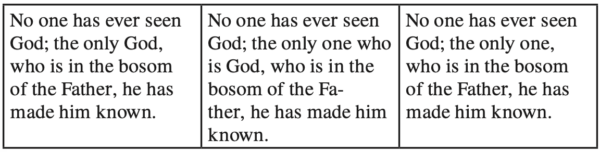
The Word that is God, Who has become flesh on earth, has made the Father known. Paul takes this a step further:
Messiah Yeshua, though he was in the form of God, did not count equality with God a thing to be grasped, but emptied himself, by taking the form of a servant, being born in the likeness of men. And being found in human form, he humbled himself by becoming obedient to the point of death, even death on a cross. Therefore God has highly exalted him and bestowed on him the name that is above every name, so that at the name of Jesus every knee should bow, in heaven and on earth and under the earth, and every tongue confess that Jesus Christ is Lord, to the glory of God the Father. (Philippians 2:6–11)
Therefore, Yeshua, although God, lowered Himself and set aside His glory to come into this world and save His people. He is the representation of the image of God in this world, something we are able to look upon without meeting death, while at the same time looking at the face of God.
However, a questions remains: If God is unable to be seen in this world but may be viewed in a vision, is there simply no instance when the Father is seen in His full glory? This question becomes important for our study since we will be dealing with prophetic visions of God on His throne. We will leave this question and ask it as we move through each prophetic revelation. For now, we turn to the prophet Isaiah.
Isaiah chapter six is one that has brought much debate. Many scholars believe Isaiah was prophesying before chapter 6, but his inauguration by God as a prophet doesn’t come until this chapter.5 No matter if this was the first prophetic vision Isaiah had or not, the prophet sets the scene by describing the throne of God in a throne room.
Isaiah has a vision of the heavenly temple or perhaps the heavenly palace as the word (he’chal) can mean both. The prophet sees “the Lord” (Adonai) high and lifted up. This is contrasted to King Uzziah who became proud, entered the earthly temple, and performed the task of a priest (2 Chron. 26:16). For this action, God struck him with leprosy (v. 19), and so he died under a curse from God, separated from others, sick and outcast. The note that the throne is high and lifted up shows exaltation. Not only is this throne exalted but it denotes power and sovereignty. The text will go on in verse 3 to refer to the one sitting on the throne not simply as Adonai, but as “YHVH”, raising the question: Is Isaiah actually seeing God?
The notice that the train or hem of His garment fills the temple is something the translators of the Tanach into other languages do not seem to like. The LXX, and the Aramaic Targum both use the word “glory” in place of “hem” or “train of His robe.” Keil and Delitzsch contend this was intentional:
The Sept., Targum, Vulgate, etc., have dropped the figure of the robe and train, as too anthropomorphic. But John, in his Gospel, is bold enough to say that it was Jesus whose glory Isaiah saw (John 12:41). And truly so, for the incarnation of God is the truth embodied in all the scriptural anthropomorphisms, and the name of Jesus is the manifested mystery of the name Jehovah. The heavenly temple is that super-terrestrial place, which Jehovah transforms into heaven and a temple, by manifesting Himself there to angels and saints. But whilst He manifests His glory there, He is obliged also to veil it, because created beings are unable to bear it.6
The reference to John 12:41 is interesting because John quotes verses 9 and 10 of this chapter, thus placing the context of John’s comment at this vision. John states:
Though he had done so many signs before them, they still did not believe in him, so that the word spoken by the prophet Isaiah might be fulfilled: “Lord, who has believed what he heard from us, and to whom has the arm of the Lord been revealed?” Therefore they could not believe. For again Isaiah said, He has blinded their eyes and hardened their heart, lest they see with their eyes, and understand with their heart, and turn, and I would heal them. Isaiah said these things because he saw his glory and spoke of him. (John 12:37–41)
The idea this vision is of a pre-incarnate Yeshua finds more support with the term “high and lifted up” which is used in Is. 52:13 as the opening verse of the pierced servant in chapter 53:
Behold, my servant shall act wisely; he shall be high and lifted up, and shall be exalted. (Isaiah 52:13)
It is used again to describe God in 57:15:
For thus says the One who is high and lifted up, who inhabits eternity, whose name is Holy: “I dwell in the high and holy place, and also with him who is of a contrite and lowly spirit, to revive the spirit of the lowly, and to revive the heart of the contrite. (Isaiah 57:15)
Thus, the description of being “high and lifted up” is used for God (i.e. YHVH) as well as the Suffering Servant who is pierced for our transgressions.
The train of His robe filling the temple shows the magnitude of this figure:
‘The hem of his robe’ indicates his majesty and splendor. It filled all the space available because ‘the heavens, even the highest heavens, cannot contain’ this exalted and incomparable King (1 Kings 8:27).7
Verse 2 describes the angelic beings that act as God’s throne attendants. The word “Seraphim” meaning “burning ones” is only used in reference to angelic beings here. The same word is used in Numbers 21 as well as Is. 14:29 and 30:6 in reference to the snakes that plagued Israel. First and second century literature has very little reference to seraphim,8 and it has been suggested that the Seraphim and Cherubim are connected as they are both worshipping angelic attendants at the throne of the Almighty. It could also be that Isaiah uses the term “burning ones” because they had a “fiery appearance.”9 Thus, to Isaiah it may be that this is not a class of angel, but rather relates to the image he is seeing. In actuality, these could be cherubim that are named “fiery” because they look like they are ablaze.
Isaiah describes these beings as standing above the throne, but one of the six sets of wings is used to fly. Thus, the angelic beings are ready to serve, but do not touch the throne of God. Instead, they hover above it. The number of Seraphim is not given, and McConville notes the scene is reminiscent of the structure on the Ark of the Covenant.10
Although Isaiah does not give too much detail about these angelic beings, we are told that they have six wings, one pair cover their feet, another pair cover their face, and the final pair keep them flying above the throne. From this, we can understand that they have feet, faces, and in verse 6 we are told they have hands as well.
We are not told how many seraphim are present, but we know there are at least two. They stand opposite each other and call back and forth declaring the holiness of God:
Fall holiness goes beyond pointing to the transcendence of the infinite God over against the finitude of creation; it also expresses divine separation from all that pollutes and degrades. Divine holiness is pre-eminently the unsullied and immaculate ethical purity of the God who is absolutely opposed to sin and evil in all its manifestations.11
Within Hebrew, if something needs to be emphasized, the language doubles. For instance, in the Torah we see the term (mot yumot) which literally means, “dying he dies.”12 This term has the word “to die” twice, which makes it magnified. Thus, the English translations of these texts will normally translate this as “he will surely die.” Yet, in our text the word is not doubled, but tripled. The implication of this is the Master of the World Who sits on the throne in heaven is not simply holy, nor is He very holy; rather, God is infinitely holy, beyond our understanding.
It is this scene that we should have in mind when we attempt to talk about the fall of man and the sin problem. We as humans attempt to comprehend the holiness of God, but it is outside of human comprehension. When man sinned, it brought unholiness into a relationship that was pure and without blemish. For God to dwell with man, the sin element, this element of unholiness, had to be taken out of the equation. But this is not as simple as we may at first believe. God is infinitely holy and thus, any mark against that holiness is in essence, an infinite transgression. A single sin transgressing God’s holiness (like eating a forbidden fruit) echoes through eternity in both directions.
The only thing that can pay for an infinite mark of unholiness, is a death that is infinite, and the only way a death can be infinite is if the life that is taken was itself infinite. Thus, Emmanuel, the only one with an infinite life, must come to pay that price. His death is the only death infinite in its impact; it pays for not only the sin of eating forbidden fruit, but for every sin that has been or ever will be committed.
The picture of the Holy One on the throne in Isaiah serves many purposes; for us, it reveals the Gospel message and the need for the suffering servant who will be pierced through for our transgressions. For Isaiah, it ordains him as a prophet because the Holy One, Who sits on the throne confirmed that Isaiah would speak for Him on this earth.
Ezekiel was a priest who was taken captive to Babylon by Nebucadnezzar in 597 (2 Kings 24:10-17). He lived with other captives near the Chebar Canal for five years before he had a series of visions. This revelation has been viewed by man, my younger self included, as odd, abstract and too dreamlike in order to gain knowledge and wisdom, causing many to quickly move past discounting its importance.
The prophet’s vision begins when he sees a cloud with fire darting back and forth with brilliant shining coming from it, like glowing amber. The Hebrew used here is obscure which has led to much speculation on exactly what Ezekiel is seeing. In reference to the word “amber” which some have translated, “amber”, Block states:
LXX translate is ἤλεχτρον, “electrum,” which identifies both amber and a gold-silver alloy. The former is probably intended here. While its meaning remains somewhat uncertain, the employment of the rare term reflects the brilliance of the image but also enhances its mystery.13
As the cloud of brilliance comes closer to the prophet, he sees four living creatures. The inability to describe these as “cherubim” suggests the prophet is unaware of what he is first seeing. This vision is paralleled with the vision in chapter 10 where the beings are identified as cherubim. In 10:15, Ezekiel recognizes the cherubim are the same angelic beings he sees here in chapter 1. The idea that these angelic beings had ranks within the heavenly realm and that the cherubim and seraphim were the highest rank among the angelic order is not found within the Bible, but comes about in later mystical texts. Although it is not specified, we will soon learn that the four living creatures are (like Isaiah Seraphim) throne attendants of the One Who sits on the throne.
The four creatures have a human likeness (although their feet are like calves hooves, cf. v. 7) most likely referring to their bodies. In comparison to Isaiah 6, we should note that the cherubim only have four wings where Isaiah’s seraphim had 6. We may also want to assume the faces of each vision’s angelic beings are different; in Isaiah, the seraphim have their faces covered with wings, but in Ezekiel, the prophet is able to see the faces of these creatures, which have four faces.
Horace Hummel states, “Their four faces looking simultaneously in all directions certainly suggest God’s omniscience and omnipresence.”14 Although Hummel specifically notes we should be careful how much we assign significance to the features of the creatures, he goes on to say:
The specific forms of the faces seem to represent the crown of four aspects of God’s creation: man is the crown of all creation, and thus this face is first and forward; the lion and the ox are supreme among the wild and the domestic animals, respectively; and the eagle is preeminent among birds. The calves’ hooves are of uncertain significance, but if they are round… they may suggest God’s omnipresence by their ability to move in any direction.15
Block agrees and after surveying the significance of each creature from an ancient perspective, he notes:
The significance of these creatures exceeds the sum of the parts. In the absence of abstract philosophical tools these images expressed the transcendent divine attributes of omnipotence and omniscience. Carrying the divine throne, the four-headed cherubim declare that Yahweh has the strength and majesty of the lion, the swiftness and mobility of the eagle, the procreative power of the bull, and the wisdom and reason of humankind.16
Each angel had human hands, but the number of their hands is not specified. The beings have four faces and four wings, but it is reasonable to suggest they only have a single set of hands since each cherub is associated with a single wheel. They do not move left or right, but stay in one position no matter where the structure goes. This makes sense since the four faces would allow them to see in any direction, but also because they are connected to a wheel, thus, it should be seen as each angel being attached to a corner of the structure without moving away from it.
The prophet has already noted that the legs of the creatures sparkled of bronze, but now in verses 13-14 we are given more detail concerning this. The creatures shine like burning coals, and out of the fire comes lightning. This once again may be the reason for the name “seraphim.”
Starting in verse 15, we are informed that there is a wheel for each angelic creature. Verse 16 reveals there are wheels within wheels. This is difficult to imagine because we are not told if the wheels move in the same direction (almost akin to spinning rims within a wheel) or if they are more like a gyroscope where the inner wheel can move in a different direction than the outer wheel. No matter how we imagine them, verse 17 explains the structure was able to move in any direction upon the earth but did not have to stay on the ground.
Several things should be noted about the wheels. First, Mackay notes that a throne or chariot where an omniscient and omnipresent God sat would not need wheels at all. He rightly contends there is a theological significance here:
They symbolized the mobility of the chariot-throne, and hence of the ruler whose throne it was. The exiles subscribed to the perception that the Lord’s presence was confined to Jerusalem, and that his commitment to the city rendered it secure come what may. Hence the chariot-throne which was able to go everywhere confronted and corrected that prevalent misperception. God was not tied to Jerusalem, but was powerfully present wherever he wished throughout his universal realm.17
Second, we have the notice in verse 20 that the “spirit of life” was in the wheels, making the point that the wheels and the angels are in complete unison being guided by the Spirit of the One upon the throne.
Verse 18 tells us the rims of the wheels had eyes all around, a fact repeated in 10:12. This is a feature we did not encounter in Isaiah, but is something we will find in other prophetic texts. Within our current passage the imagery of the eyes along with the wheels and the faces of the angelic beings, all point to the idea of the One Who sits on the throne being omniscient and omnipresent. There is no need for Him to turn as He sees, hears, and knows all things. He is ruler over all creation and nothing slips from His notice.
The prophet now looks up. Above the heads of the angelic beings is the (rakiah), a word used four times in verses 22-26. It is the same word used in Gen. 1:6-8 and 14-20 in which God places the sun, the moon, and the stars and is there translated “expanse” and “firmament.” In this instance the prophet uses the word to describe a platform that shined like awesome crystal, or was awe inspiring. The use of (rakiah) most likely signifies the same element as the eyes and the intricate wheels. The platform of God is the entirety of heaven. There is nowhere His domain ends. We should probably have Exodus 24:9-10 in mind where the elders of Israel see the God of Israel:
Then Moses and Aaron, Nadab, and Abihu, and seventy of the elders of Israel went up, and they saw the God of Israel. There was under his feet as it were a pavement of sapphire stone, like the very heaven for clearness. (Exodus 24:9–10)
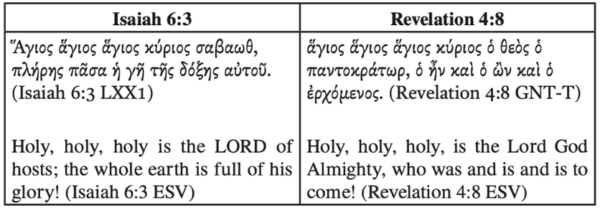
Instead of the “Lord of Hosts” found in Isaiah, John hears the end of line one as “Lord God Almighty.” The second half of the phrase is completely different. The threefold name of God coupled with the last phrase giving past, present, and future is used to show God’s total sovereignty over time and creation. There has never been a moment when God was not in full control.
Chapter 4 finishes with God on the throne being worshipped by the angelic beings along with the 24 elders. God is once again said to live forever and ever. He is also said to have created all things, something that is attributed to Yeshua in 1 Cor. 8:6, Col. 1:16, Heb. 1:2-3.
John’s vision now shifts to focus on a new character. Like Daniel, there is another who appears, but for John it is a lamb. The contrast is made between the name in verse 5 “the lion of Judah” and the image that is seen of a slaughtered lamb.
The book that is seen in Daniel comes into the scene. Daniel told us the books were sealed in 12:8-9; now we see them, still sealed with no one able to open them. As mentioned above, some believe these books are the scrolls of the Torah, and only the Lamb can unlock them because only He can correctly interpret the law of God. Beyond this, judgement comes through Yeshua since His blood is what makes believers righteous but the unrighteous will be judged according to the law. While such an interpretation seems correct, Beale thinks it could have some problems:
Others understand the “book” as representing the scroll of the OT. Christ alone is able to unlock (“open”) the true meaning of the OT, since its prophecies have found fulfillment in him (cf. 2Cor. 1:20; Matt 5:17). This proposal is consistent with the entire Apocalypse because of its focus on how Christ fulfills OT prophecy. However, against this view is the observation that the books of Daniel 7, Daniel 12, and Ezekiel 2-3 do not symbolize the OT but primarily decreed events of judgment.42
John now sees the lamb that has been slain. This should bring our minds to the binding of Isaac and Abraham’s prophetic saying “God will provide for Himself the lamb for an offering.” We may also remember the Passover lamb that was sacrificed and its blood spread on the doorpost.
The lamb has seven horns. Perhaps this is a contrast to the beasts in Daniel with horns that oppose God, this lamb has seven horns that represent God’s spirit. This most certainly can be linked to Zechariah’s prophecy which says the King would rule not by might or power (like a lion), but by the Spirit:
Then he said to me, “This is the word of the LORD to Zerubbabel: Not by might, nor by power, but by my Spirit, says the LORD of hosts. (Zechariah 4:6 ESV)
The lamb takes the scroll from the One sitting on the throne and now, something that would be nothing less than shocking to a Jewish audience, the four angelic beasts and the 24 elders turn and worship the Lamb. Beyond this, the prayers of the saints, which are prayers for the Lamb to release plagues on those who oppress them (Rev. 6:10, 8:4-6), are offered to Him.
When discussing the Revelation 4-5 and the final scene in chapter 5, Osborn notes:
In chapter 4 the sovereignty and majesty of God is central, and worship predominates. In chapter 5 the Lamb takes the spotlight and stands “in the center of the throne” (5:6). The worship (5:9, 12) shifts to him, and the final scene of worship celebrates the unity of the two figures (5:13-14). Moreover, the hymns progress from the living creatures (4:8), to the elders (4:10-11), to both groups together (5:8-9), to the myriad angels (5:11-12), to “every creature” (5:13). The progression is powerful: first in groups and then finally as the greatest choir ever assembled, all creation, joins in worship of the Godhead.43
John’s vision of the throne room of God combines imagery from Isaiah, Ezekiel, Daniel, and Zechariah. His vision serves as progressive revelation of the images we are already familiar with from the prophets. Beyond this, the throne of God found in these two chapters “dominates the rest of the book and prepares for everything that follows.”44
The imagery from the four passages we have already surveyed come together in Revelation 21 where God’s presence enters this world. The scene depicts Jerusalem adorned as a bride, ready for her Groom. The language is taken from Isaiah 52:10:
Awake, awake, put on your strength, O Zion; put on your beautiful garments, O Jerusalem, the holy city; for there shall no more come into you the uncircumcised and the unclean… How beautiful upon the mountains are the feet of him who brings good news, who publishes peace, who brings good news of happiness, who publishes salvation, who says to Zion, “Your God reigns…
The LORD has bared his holy arm before the eyes of all the nations, and all the ends of the earth shall see the salvation of our God. (Isaiah 52:1, 7, 10)
Isaiah’s imagery of marriage is developed fully in 61:10:
I will greatly rejoice in the LORD; my soul shall exult in my God, for he has clothed me with the garments of salvation; he has covered me with the robe of righteousness, as a bridegroom decks himself like a priest with a beautiful headdress, and as a bride adorns herself with her jewels. (Isaiah 61:10 ESV)
The throne of God is now on earth. Pain and suffering is done away with and the dwelling place of the Almighty God is now in the physical world.
John describes the New Jerusalem, but one thing is missing. In 21:22, we are told there is no physical temple, because the Lord and the Lamb are the temple. God dwells with His people and the world itself is the temple. At this point, John’s language mirrors Isaiah and Jeremiah. The contrast is stark. The former prophets described a temple that would be built where John contends the temple is God and the Lamb. The language of Jeremiah is certainly in mind here as he quotes portions of Jer. 3:16-17:
And when you have multiplied and been fruitful in the land, in those days, declares the LORD, they shall no more say, “The ark of the covenant of the LORD.” It shall not come to mind or be remembered or missed; it shall not be made again. At that time Jerusalem shall be called the throne of the LORD, and all nations shall gather to it, to the presence of the LORD in Jerusalem, and they shall no more stubbornly follow their own evil heart. (Jeremiah 3:16–17 ESV)
John’s vision also mirrors that of Isaiah 60, where we are told the sun and moon will not be the source of light:
The sun shall be no more your light by day, nor for brightness shall the moon give you light; but the LORD will be your everlasting light, and your God will be your glory. (Isaiah 60:19 ESV)
Zechariah describes something like this as well when he states:
On that day there shall be no light, cold, or frost. And there shall be a unique day, which is known to the LORD, neither day nor night, but at evening time there shall be light. (Zechariah 14:6–7 ESV)
Again we see the same scene being described in Rev. 21:25-26 as in Is. 6:3-5, 11 and Zech. 14:16-17.
Revelation 22 depicts a river that flows out of Jerusalem. This river is also described in Ezek. 47 and Zech. 14:8. Once again, the difference seen in John’s vision is the absence of a physical temple but the picture is the same. Living waters flow from Jerusalem in both summer and winter bringing prosperity to any land it touches.
John’s vision also notes that nothing will be cursed bringing our minds back to the garden of Eden where God dwelt with mankind in perfect harmony.
The singular throne of God is now inhabited by God and the Lamb. John tells us that God and the Lamb will be in Jerusalem and His servants will worship “Him”, a third person masculine singular which clearly refers to both God and the Lamb. “The two are conceived so much as a unity that the singular pronoun can refer to both.”45 This may also be a veiled reference to the unity of God mentioned in Zech. 14:9:
And the LORD will be king over all the earth. On that day the LORD will be one and His name one. (Zechariah 14:9 ESV)
The Zechariah passage is important because it places these events directly at the time of Sukkot. John’s picture of rivers flowing out of Jerusalem, there being no night or day but eternal light, God dwelling with His people, and there being no curse is a reference to the garden of Eden where sin did not exist and man dwelt in perfect harmony with God. This is the picture of the throne on earth. The Garden and the festival of Sukkot are synonymous. The glory of God is among His people.
When we celebrate the festival of Sukkot, we are looking forward to the throne of God that is described in the heavenly throne room coming to earth and God’s radiant glory filling this world. The newness of heaven and earth is the ability to exist in the presence of the full glory of the Almighty. Sin is taken away, and the magnificence of God’s presence, seen throughout the Scriptures and experienced through Yeshua, is complete on this earth.
When we celebrate Sukkot, we do not simply think of this life being temporary, we think of this world as we know it being temporary and sin and death being abolished. This is the vision of the new heavens and new earth. A restoration of the garden’s original state, where God and man dwell without any curse, without pain, and death shall be no more. Ultimately, Sukkot is the looking forward to a fulfillment of the Lord’s Prayer, “Your Kingdom come, Your will be done, on earth as it is in heaven.”
When we speak these words our minds should not only be reminded that we are looking forward to life eternal with no death, but we should recognize the images of the King on His throne in the heavenly throne room, which will burst into a physical reality on this earth and will change every aspect of our world. This is the celebration of Sukkot.
